Measuring a window: width, drop and the rod nobody measures
How to measure for curtains that still gather when closed, why the rod matters more than the glass, and which drop suits which room.
Why the glass is the wrong thing to measure
When you pull out a tape measure for a new window, the glass is the first thing you reach for. It sits right there. It has clear edges. The number you get feels solid, and it is the wrong number to give us. We see this mistake every day, and we want you to avoid it because the panels you order will fit the way they should.
Here is what happens when you measure the glass. You get the width of the opening, not the width of the frame around it. Our curtains need to cover that frame, and they need to extend past it on both sides so light does not leak in at the sides. If you send us the glass measurement, your panels will fall short. They will stop at the edge of the window reveal instead of covering the wall beside it. That gap lets in more light than most people expect, and it makes the whole treatment look narrow.
The drop works the same way. Measure from the top of the glass and you miss the space above the window where the rod actually sits. Most rods mount four to six inches above the frame. If you measure down from the glass, you lose those inches, and your curtains will hang too short to reach the floor or the sill the way you planned.
We make panels in specific widths and drops because fabric has a finished size once we cut and hem it. When you order, you are ordering that finished size. We cannot add material after the fact. So measure the space you want covered, not the hole in the wall. Run your tape across the full width of the area, including the frame and the extra inches on each side. Measure from where the rod will hang down to where you want the fabric to end. Write down those two numbers. Those are the ones that matter when you choose a panel from our catalogue.

Rod width, fullness and how much fabric you need
The rod you choose matters more than most people realize. We measure our finished panels in inches, width by drop, and that width is the flat measurement of the fabric itself before it goes on a rod. It is not the same thing as the span of your window. If your window frame measures 60 inches across, you do not want 60 inches of fabric. You would end up with something pulled tight and flat, and it would not look or hang the way we intend it to.
What you are really deciding here is fullness: how much extra fabric you give that panel so it can fold and drape as it should. For grommet panels and rod pocket styles, we generally suggest one and a half to two times the rod length. A 60 inch rod would take roughly 90 to 120 inches of combined fabric width. That gives each panel room to form soft, even folds instead of hanging straight down like a sheet.
Back tab and tab top headings work a little differently. They sit differently on the rod, so they often need less additional width to look right. Pleated headings already build the folds into how we make them, so you follow the measurements we give for those more closely.
Look at what we list for each pack. Most of our curtains tell you how many panels come in it and what size each one is. Two 50 inch wide panels give you 100 inches of total fabric to work with. That covers a rod of roughly 50 to 66 inches depending on how full you want the final look to be. Sheers can often take more fullness because the fabric is light enough to carry it without looking heavy. Velvet and thicker blackout weaves usually need less. They have enough body on their own.
If you are between sizes, go wider. You can always gather a panel a bit more tightly on the rod. You cannot add fabric you did not buy. Measure the space where the rod will actually sit, not the glass, and check the finished dimensions we publish for the product you are considering. It saves you from ordering twice.

Reading a panel size on a card
When you look at a product card, the size you see there is the finished panel. We write it as width by drop, and it means what it says: that is how wide each panel measures once you hang it up, and how long it runs from top to bottom. The number on the card is not the rod coverage or the window width. It is one panel, laid flat.
This matters because nearly all of our curtains sell in multi-panel packs. Most come in pairs. Some of our shorter kitchen tiers and valances arrive as sets of two or four panels. When you read "52 by 84 inches" on a blackout curtain card and the pack contains two panels, you are getting two pieces, each one 52 inches wide and 84 inches long. Side by side, those two panels cover roughly 104 inches of rod space before you account for the natural overlap in the middle where they meet.
We state the finished size for 357 of our products across the catalogue. If you are measuring your window and calculating how many panels you need, use that finished width number. Multiply it by the number of panels in the pack, then subtract an inch or two for the overlap where the panels draw closed. That gives you the actual span you will cover on your rod.
The heading type affects this slightly but does not change the panel width itself. Grommet panels hang from metal rings at the top, so the fabric sits just above the rod. Rod pocket curtains thread directly onto the pole. Back tab and tab top headings attach differently, but the fabric dimensions we print stay the same regardless of which style you choose.
Check two things before you add anything to your cart: the individual panel size, and the count inside the pack. Write down both. Then measure your rod or the space you want to cover, do the quick math, and you will know whether one pack handles the window or whether you need to order a second set to fill it out properly.
Where the rod goes: high, wide and why
Most people pick a rod that matches the width of the window frame. It makes sense on paper. In practice, that choice costs you light coverage at the sides, and it makes whatever window you have look smaller than it actually is. We have watched this mistake repeat across thousands of windows, so we will tell you what we tell anyone who asks us before they order.
Go wider than you think you need. Measure the frame opening. Add eight to twelve inches on each side for a standard window, and closer to fifteen if you can manage the wall space. When you pull those panels back, they should clear the glass entirely. That does two things at once. It lets in the full amount of daylight when you want it open, and when you close them, the fabric overlaps the wall around the window instead of sitting right on the glass edge.
Light leaks around the sides of almost any curtain because gaps exist where the rod ends and the fabric begins. You minimize that gap by extending the rod.
Now consider height. Mount the rod four to six inches above the top of the trim. Higher is usually better within reason. This trick draws the eye up, and it adds visual height to the whole room. If you have the ceiling space, we suggest going as high as halfway between the top of the window and the crown molding or ceiling line. The exception here is if you are covering a sliding door or a very tall picture window where the panel length becomes unwieldy. In those cases, stay closer to four to six inches and choose your drop accordingly.
Think about clearance behind the rod too. Grommet panels need roughly an inch and a half of rod clearance above the top of the grommet so they can slide without catching. Rod pockets sit directly on the rod, which means they take up less vertical space but do not move as smoothly. Back tabs hide the rod entirely and give you a tailored fold at the top, though they require a little more patience when you open and close them.
One last point about return. If your rod has a decorative finial that sticks out, account for that in your total width. We state finished panel sizes in inches for most of our curtains, and those measurements reflect the flat width of the fabric itself. They do not include the space the rod hardware occupies. Measure the space you have, subtract an inch or two for bracket wiggle room, then match your panels to that number rather than to the window glass alone.
Choosing a drop: sill, apron or floor
The drop is how far the panel falls from the rod. It matters more than you might think, and it is the measurement people second-guess most after they hang their curtains.
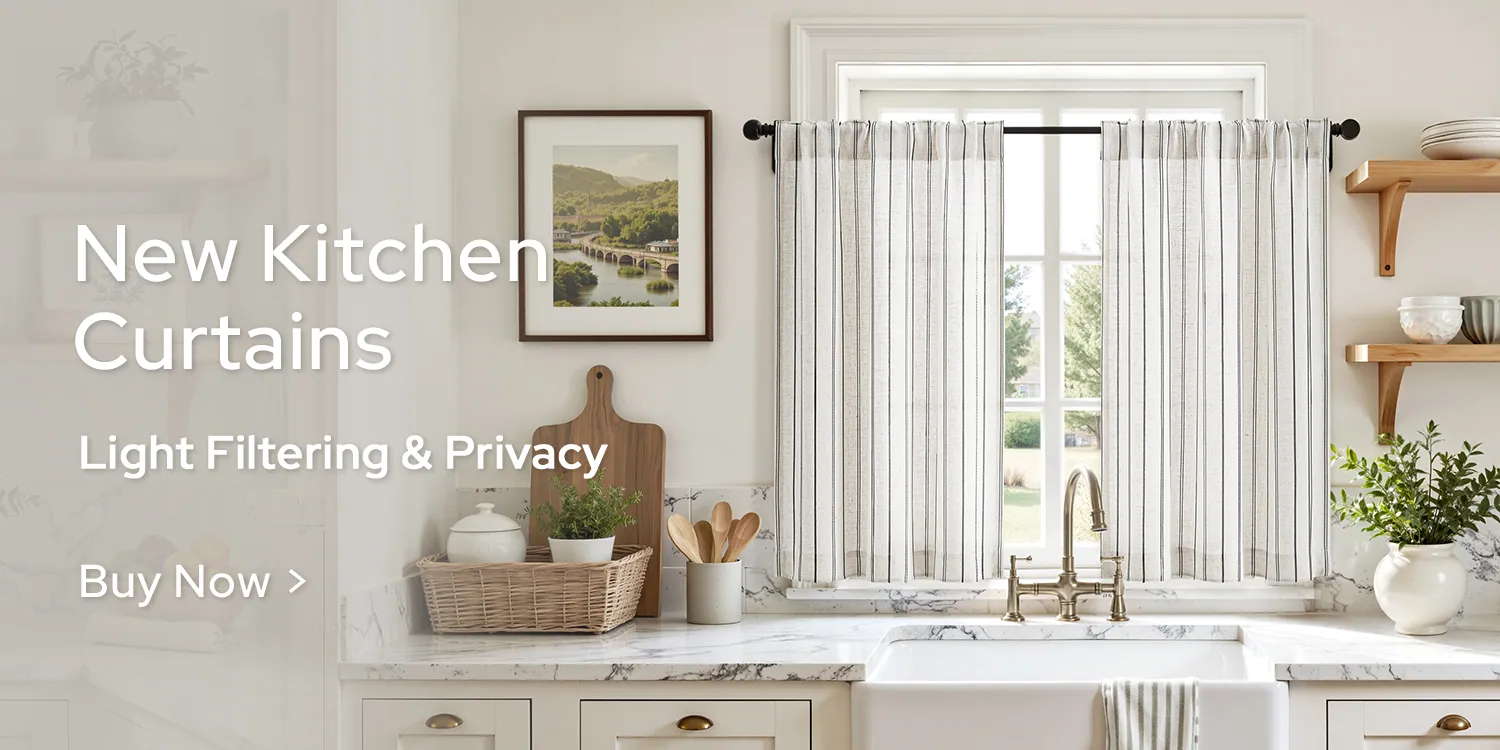
Three standard lengths cover most windows. Sill-length panels stop right at or just above the windowsill. This works well in kitchens and bathrooms where you want to reach the glass easily for cleaning, and it keeps the fabric away from water splashes. Our kitchen tiers and door panels are made with this placement in mind. If your window has a deep sill, let the fabric rest on it by about a half inch. That small overlap stops light from leaking underneath at night.
Apron-length curtains fall four to six inches below the sill. We use this drop on many of our living room and bedroom styles because it makes the window feel taller without committing to full floor length. It also keeps the hem clear of radiators, vents, or furniture you might push against the wall. When we design blackout panels, this is often the length we recommend first. The gap between hem and floor means less dust kicks up when you walk past, and the panel does not drag across carpet or hardwood.
Floor-length curtains are our longest option. The fabric should skim the floor or break on it slightly, like trouser cuffs, by about half an inch to an inch. Pools of excess fabric look intentional on velvet drapes, but most woven materials sit better with a clean finish near the ground. Measure from the rod to the floor, then subtract a quarter inch if your rod will sag slightly under weight. Our triple-woven blackout fabrics have enough body to hold a straight line all the way down, so you do not need extra length to compensate for stretching.
Pick your drop before you order. A panel that is too short cannot be fixed, but one that is too long can always be hemmed.
Puddling, breaking and hems that touch
The hem of a curtain is where your measurement decision shows. Get this right and the panel looks like it belongs in the room. Get it wrong and you notice it every time you walk past.
We make our panels with a finished drop listed in inches. That number tells you exactly how long the fabric is from the top of the heading to the bottom edge. What we cannot tell you is where that bottom edge should sit on your wall, because that depends on your floor, your rod height, and the look you want.
Three options come up most often. The first is breaking at the sill. The hem sits just above the windowsill, so the fabric does not touch it. This works for kitchens and bathrooms where you want the panel to clear the counter or tub ledge. Our kitchen tiers and door curtains are cut for this kind of placement. You measure from the rod to about a half-inch above the sill and match that to the drop we list.
The second is floor length with a slight break. The curtain touches the floor but does not bunch up. It creates a clean line that works in bedrooms and living rooms. Measure from the rod to the floor and subtract a quarter to half an inch so the hem brushes the surface without dragging. Most of our blackout panels and sheer curtains look their best hung this way.
The third is puddling. You let extra fabric pool on the floor by an inch or more. This gives a relaxed, formal look that suits heavier materials like velvet and chenille. We see it most often with our velvet curtains and some of the embroidered styles. Add two to four inches beyond the floor measurement if you want this effect. Keep in mind that puddled hems need more care when you vacuum or sweep, and they will shift when you open and close the drapes.
Whatever you choose, measure twice before you order. We cannot alter the drop after the panel leaves us, so the number you pick is the one you will live with.
Doors, radiators and windows that open inward
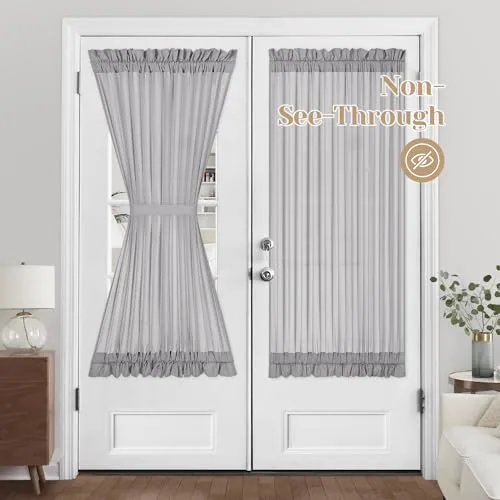
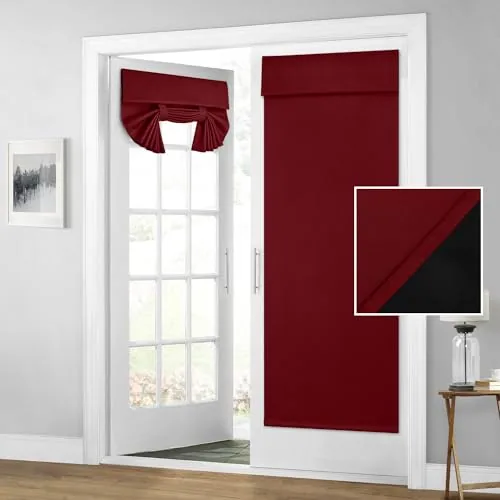
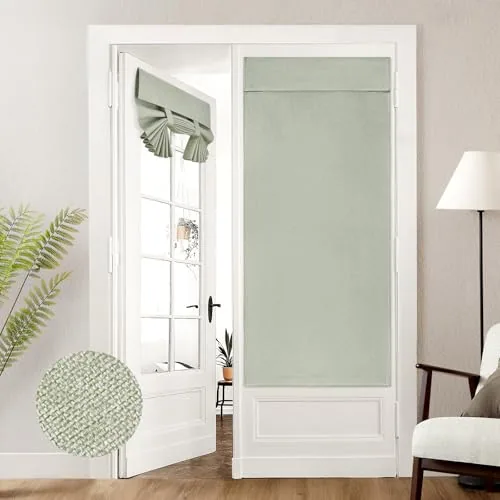
Doors that swing toward you are one of the trickier spots to dress, and they come up more often than you would think. The problem is simple: if a curtain hangs in the path of the door, it will bunch up every time someone opens it. Over time the fabric crushes at the bottom and the rod can loosen from the repeated pressure. We see this most often with French doors and pantry doors, and that is why we keep our door panel collection at 61 styles. Most of them sit between 40 and 72 inches long, so they clear the handle without pooling on the floor.
The same logic applies to windows that open inward. Casement and hopper windows need room to swing into the room, and a standard curtain mounted too close to the glass will block them completely. You have two real options here. The first is to mount your rod four to six inches above the frame, which gives the window clearance to open without hitting the fabric.
The second is to choose a shorter panel that stops above the sash. Our kitchen tiers were built for exactly this situation: they cover the lower glass while leaving the upper window free to crank outward. At 24 to 36 inches in length, they work on casement windows without any interference.
Radiators under the window demand their own attention. We never want long curtains draping directly over a heating unit. Fabric that touches a hot radiator can discolor, trap dust, and in some cases pose a safety risk. If you must use full-length panels there, we suggest pulling them back with a tie during the months when the heat runs. A better approach for many rooms is a tier or a valance that sits above the radiator entirely. About two-thirds of our blackout panels and most of our sheer styles can be styled this way if you measure for the shorter drop instead of the floor.
The thing we tell people most often: measure the actual space the door or window needs to move through before you pick a size. A few extra minutes with a tape measure saves the frustration of fabric that fights you every time you walk through the room.
Two panels or one, and when a pair is not a pair
Most of our curtains sell as pairs, and we list the finished size of each panel separately. When you see "52 by 84 inches, 2 panels," that means two panels, each one measuring 52 inches wide. You get 104 inches of width across your window when you hang them side by side. This matters because some brands add the two panels together and call that the width, which can leave you short when you unpack the box.
A single panel works for narrow windows, for a door you want to cover on one side only, or when you are layering a sheer behind a blackout and want to control each side independently. Our sheer and privacy curtains, along with many door panel styles, often come this way. Check the pack count before you order: we state it clearly on every product, and 328 of our cards include it in the specifications.
Here is where people get caught out. A pair is not always two identical panels cut from the same bolt of fabric. Some of our embroidered and patterned designs use a mirrored layout so the pattern flows across your window when the panels meet in the middle. The left panel is not simply a duplicate of the right one. If you order a single panel from a set like that, you will receive one half of the complete design, which looks intentional on a narrow window but incomplete on a wide one.
We weave our blackout fabric as triple-layer cloth rather than coating the back, so each panel has enough body to hold its shape without a partner. But even with that structure, most windows look fuller with fabric spread across more of the rod. A good rule we follow ourselves is one and a half to two times the rod length in total fabric width. Two panels give you that automatically. One panel on a standard window can look sparse no matter how heavy the material feels in your hand.
Rings, hooks and the hardware that changes your numbers
The hardware you pick will change how your curtains fit, often by an inch or two in each direction. It is worth sorting this out before you measure, because the numbers on our panel sizes assume a specific setup and yours might not match it.
Grommet panels are the most common choice we make. The metal ring at the top of each panel sits on the rod, and the fabric starts roughly half an inch above that ring. This means you need about an inch of clearance above your rod for the grommet to slide freely. If you mount the bracket tight to the frame, the panel will bunch up when you try to open or close it. We build our grommets with an inner diameter of 1.6 inches, so any rod up to one and a quarter inches thick will move smoothly inside them.
Rod pocket headings work differently. You thread the rod through the fabric sleeve at the top, so the curtain hangs from the rod itself. This costs you between one and three inches of visible drop depending on how deep we cut the pocket. Our standard pockets are three inches deep, which means three inches of fabric sits above the rod and does not count toward what you see hanging down. If you have exactly 84 inches from rod to floor, a 84-inch rod pocket panel will hover slightly off the ground because part of its length is tied up in that top fold.
Back tabs and tab tops hang below the rod rather than around it. A back tab tucks behind the main panel and grips the rod from the rear, while a tab top shows fabric loops stitched to the heading. Both styles give you almost the full drop of the panel as listed, minus maybe half an inch where the fabric connects to the rod.
Hooks add their own variable. If you use decorative rings with clips, the clip itself takes up roughly an inch at the top edge of the panel. Pinch pleat panels meant for traverse rods attach through hooks that sit several inches below the rod position, which shortens your effective drop by that same amount.
We recommend measuring twice once you know which heading you want. Write down whether you plan to use grommets, a pocket, or clips, then check that math against the ceiling height and the distance from your rod to the floor. An extra minute here saves a return later.
Measuring twice, ordering once
Write down every number as you take it. Not in your head, not on a scrap you will lose. A notebook, your phone notes, whatever works for you. The moment you put the tape measure away is the moment those figures start to blur. We have seen enough windows to know that what feels like forty-two inches at 7 p.m. can look like thirty-nine the next morning when you are squinting at an order form.
Measure the width in three places. Top, middle, and bottom of the frame. Windows settle over time, especially older ones. The difference between those numbers might be half an inch or it might be more. Write all three down, then use the widest one. If you order for the narrowest point and your window turns out wider where it counts, the panels will not meet in the middle. That gap lets light through on a blackout curtain, and it shows.
Do the same thing for the drop. Measure from where you want the rod to sit down to where you want the fabric to end. Left side, right side, maybe the center if your floor looks uneven. Use the longest measurement here. You can always hem a curtain that hangs too low. You cannot add four inches to one that comes up short.
Check your heading type before you do any math. Our grommet panels need about an inch and a half of rod above the top of the panel itself. Rod pockets sit right on the rod. Back tabs and tab tops each eat up a little differently. If you measured from the rod position to the floor but forgot to account for how the curtain attaches to that rod, you might end up with fabric that stops awkwardly below the sill or pools more than you wanted.
Read the product description once you have your numbers. We list finished panel sizes in inches for most of our curtains, so you can see exactly what will arrive. Check whether the pack includes one panel or two. Check the width of a single panel and do the math for your window. Two forty-inch panels give you eighty inches of coverage across a sixty-inch window, which means fullness and proper draping. One panel on that same window leaves you with bare glass on both sides.
Then measure again. Same spots, same tape, fresh eyes. If the numbers match what you wrote the first time, you are ready to order. If they do not, figure out which reading is right before you commit. Curtains are not hard to return, but measuring twice saves you the trip.