What 100% blackout really does to a room
What blackout fabric blocks, what still gets past it, and what the sleep research actually says about light in a bedroom.
Blackout is a fabric claim, not a room claim
When we label a curtain "100% blackout," we are talking about the fabric itself. Not the room. This distinction matters more than almost anything else on the page, and it is the one thing people misunderstand before they buy.
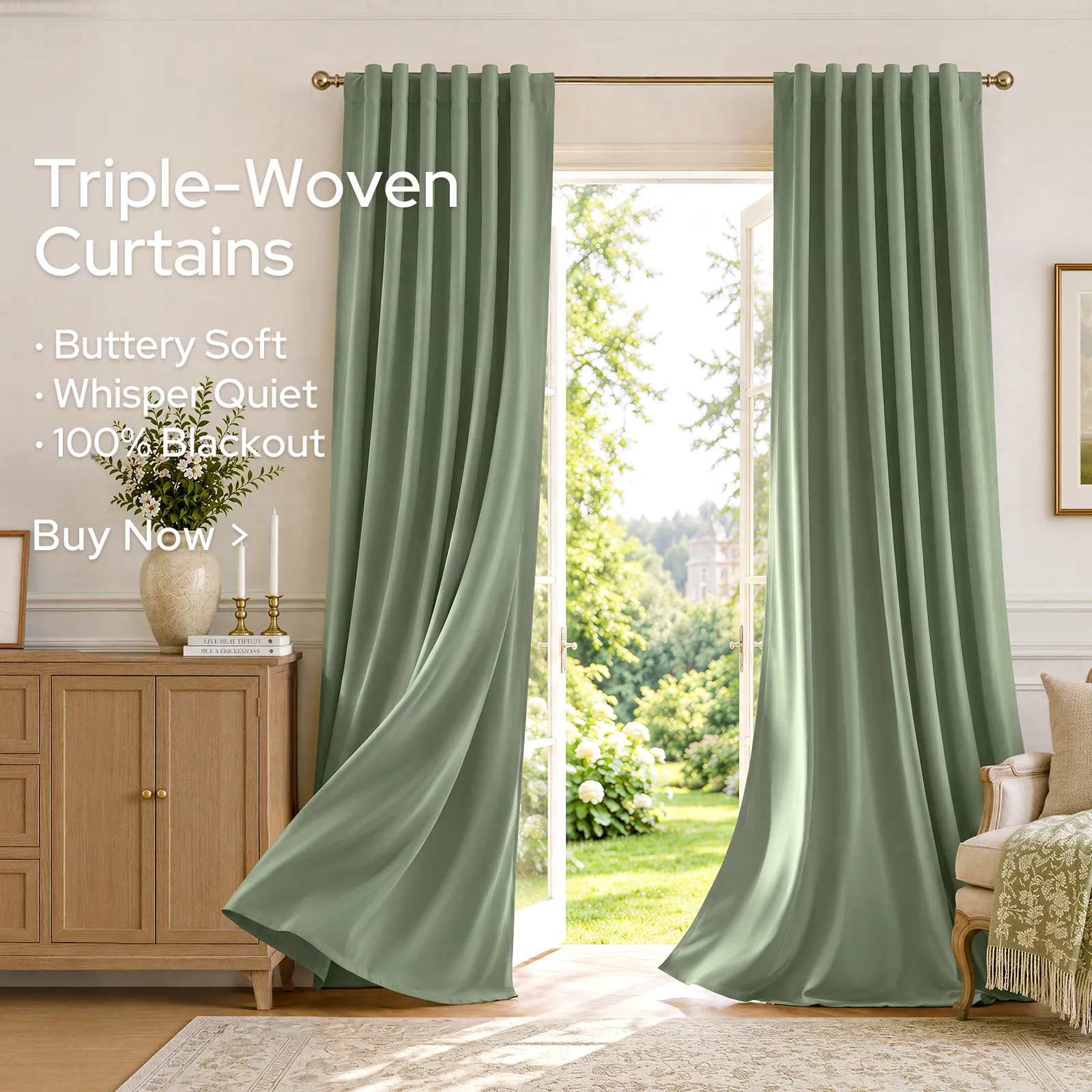
Our triple-woven blackout curtains block light through the material. We weave that light-blocking layer into the cloth, so nothing is glued or coated on the back. The panel itself will not let daylight through. Hold it up to a lamp, and you will see what we mean. The fabric does its job.
But a window has edges. Light comes in above the rod, below the hem, and around the sides where the panel meets the wall. We cannot control that, and no curtain can. If you need total darkness for sleep or shift work, you will want to measure carefully and consider how your panels sit relative to the frame. A wider panel that overlaps the wall by a few inches on each side will close most of those gaps.
We make 132 blackout products across our range. Some are room darkening, which cuts most light but not all of it. Others carry the full 100% blackout label because the fabric earns it. Check which one you are looking at before you decide.
The room will not go pitch black on its own. It rarely does, even with the best panels we know how to make. What you get is a fabric that pulls its weight, hung in a space where some light always finds another way in. That is an honest claim, and it is the only one we are comfortable making.
Where the light gets in anyway
Even the best blackout fabric can't seal a room on its own. We weave our blackout panels with three layers so no light passes through the material itself, and we stand by that. But fabric is not a door. Light finds the gaps around it, and it helps to know where those gaps are before you measure your windows.
The top of the rod is usually the biggest leak. Most rods sit an inch or two out from the wall, which leaves a thin triangle of open space above the curtain. You will see it most clearly when the sun hits that gap directly in the morning or late afternoon. A rod with a deeper return bracket sits closer to the wall and closes much of that triangle, though you can also extend your panel a few inches past the top of the frame so it overlaps the space above.
The sides matter more than people expect. Our panels come in specific widths, and if the combined width of your panels does not reach at least one and a half times the window width, the fabric will pull open at the edges when it gathers on the rod. That lets light stream in along both sides. We list finished panel dimensions for 357 of our products so you can calculate whether two or three panels will cover your window without stretching.
The bottom has its own problem. If the panel stops half an inch short of the sill or floor, a bright line shows underneath. Gravity pulls the fabric down over time as well, especially after washing, so what reaches the floor today may ride up slightly in six months. We recommend ordering a drop that clears your sill or floor by at least an inch.
None of this means the fabric is not doing its job. It is. The triple-woven layers block every bit of light that touches them. What gets through travels around the edges instead, and you can close most of those paths with the right measurements and a rod that hugs the wall.

How blackout fabric is built
Most blackout curtains you will find use a coating. A layer of paint or rubber gets brushed onto the back of ordinary fabric after the cloth is already woven. It blocks light, yes, but it also makes the panel stiff. The material does not fold softly. Over time that coating can crack or peel away in flakes.
We do not make curtains that way. Our blackout fabric uses triple weaving. Instead of adding a layer afterward, we weave three separate layers together at the loom. The blackout layer sits in the middle, locked between the face fabric and the backing. Nothing is glued on. Nothing can rub off or separate because it was never applied as a coating in the first place. The light-blocking yarn is part of the cloth itself.
This changes how the curtain behaves in your room. Because there is no stiff backing baked onto one side, the fabric drapes the way good textile should. It falls into soft, natural folds from the rod to the floor. You can gather it with a tieback and it holds a rounded shape rather than creasing into hard angles. The hand feel is different too: smooth and supple, not slick or rubbery.
We test every new weave before we add it to our range. A sample hangs at a window for weeks while we watch how morning light hits it, whether the weight pulls evenly along the hem, and what a wash cycle does to the drape. If a fabric goes stiff after laundering or loses its softness, we do not sell it. That is why 132 of our panels carry the blackout label and 524 of them are machine washable. The construction has to hold up to real use, not just look right on a hanger.
The middle layer also helps with temperature and sound. Across our catalog, 136 products list thermal insulation and 109 note noise reduction. Those are side effects of the dense triple structure. More material between you and the window means less heat transfer in summer and less warmth escaping in winter. It also dampens street noise somewhat, though no curtain silences a room entirely.
When you shop, check whether a product says "triple-woven" or describes its construction. If it only promises darkness without explaining how the fabric achieves it, ask what is actually blocking the light. A woven-in blackout layer keeps working wash after wash. A painted one will not.
Light, melatonin and the body clock
Your body does not need a clock on the wall. It has one inside, and it runs on light. When sunlight hits your eyes in the morning, a cluster of cells behind your forehead gets the signal. It tells your brain to stop making melatonin, the hormone that makes you feel ready for sleep. Your temperature rises. Cortisol kicks in. You feel awake.
The problem is that your internal clock cannot tell the difference between morning sun and a streetlamp at eleven at night, or the glow from a neighbor's porch light seeping through the edges of your curtains. To your brain, light is light. If it arrives when it should not, your body pushes back the sleep signal by an hour or two. You lie there wondering why you are not tired yet. The next morning you drag yourself out of bed because you never got into deep sleep.
This is what our blackout fabric addresses. We weave the light-blocking layer into the cloth itself rather than coating or lining it afterward. That triple-woven construction stops light from passing through the panel. We do not claim that a room goes pitch black, because some light always finds its way around the sides and over the rod. But the fabric itself blocks the direct glow that would otherwise reach your eyes from outside.
We have watched how this works in practice. A panel that filters light looks pleasant during the day but it will not protect your melatonin production after dark. You need something that closes out the external illumination so your body can follow its own rhythm. Most of our blackout curtains use that triple-woven method for exactly this reason. Check the product details to confirm which ones carry the full blackout rating versus room darkening or light filtering. The difference matters if you sleep during daylight hours or you live where artificial light stays on through the night.
Good sleep is not about luxury. It is about giving your body the conditions it expects. Dark enough, quiet enough, steady enough. We make the panels. You decide whether the tradeoff is worth it.
Melatonin—a hormone released by the pineal gland—helps you feel sleepy when it gets darkU.S. National Institute of Neurological Disorders and Stroke, Brain Basics: Understanding Sleep, read 22 August 2026
Waking at three and getting back to sleep
Most of us have been there. You wake at 3 a.m. for no reason you can name, and the room is not quite dark. Maybe a streetlamp has shifted its angle since winter, or a neighbor left a porch light on. It does not take much. A thin line of brightness along the top of the frame, a faint glow bleeding in at the sides, and your brain registers it as morning. By the time you look at the clock, you are wide awake and annoyed about it.
This is the problem we built our blackout curtains around. Not the idea of a darkened room for movie night, though that works too. The real reason people reach for these panels is sleep. Specifically, the kind of sleep that stays asleep when something outside decides to shine through your window.
Our triple-woven blackout fabric blocks light at the thread level. We do not apply a coating or back the material with anything stiff. The light-blocking layer is woven into the cloth itself, so the panel hangs softly and drapes the way good curtains should. What matters here is what happens when the panel is up and the room is actually dark. Your eyes stop hunting for light sources. That glow that used to sit on the ceiling from the street below simply does not appear anymore.
We cannot promise you will never wake at three again. We do not make that claim because it would be dishonest. Light sneaks in around the edges of any curtain, over the rod, under the hem. What we can say is this: with our blackout panels in place, the light that reaches your eyes drops to almost nothing. The difference between a room with standard curtains and one with proper blackout is the difference between noticing it is not pitch black and not noticing anything at all.
If you sleep lightly, or if your bedroom faces a source of artificial light that will not turn off, this matters more than thread count or color. Pick a panel size that extends well past your window frame on every side. The wider the overlap, the less stray light finds its way in. Install them, wash them when you need to, and see whether the next 3 a.m. passes without you knowing it happened.
Exposure to light can make it difficult to fall asleep and get back to sleep if you wake up during the nightU.S. National Institute of Neurological Disorders and Stroke, Brain Basics: Understanding Sleep, read 22 August 2026
Nurseries, shift work and daytime sleep
A dark room is not a luxury when you need to sleep while the sun is up. For shift workers, new parents, and anyone on a schedule that runs against the clock, it is a practical necessity. We designed our blackout curtains around this problem, and we hear about it often enough to know that the details matter.
Our triple-woven blackout fabric blocks light at the material itself. We do not apply a coating or a liner to the back of the panel. Instead, we weave the light-blocking layer into the cloth as we make it. This matters for two reasons. First, the fabric stays soft and drapes naturally from the rod rather than hanging stiff. Second, it holds up to washing without the backing cracking or peeling away. All of our blackout panels are machine washable, and we have tested them through cycles of laundering to be sure they keep doing their job.
We should be clear about what the fabric can and cannot do. Our 100% blackout rating refers to the material itself. It will stop direct light from passing through the weave. What it cannot do is seal a room completely. Light will still enter along the top of the rod, down the sides where panels meet, and underneath the hem if your curtains do not reach the floor or the windowsill.
We mention this because we want you to choose with accurate expectations. If you are setting up a nursery or a bedroom for daytime sleep, you can close most of that gap by selecting a panel size wider than your window frame and ordering a drop that goes past the sill or all the way to the floor.
Noise reduction is another factor here. Many of our blackout styles also cut down on sound from outside, which helps when traffic or neighborhood activity picks up during the hours you need quiet. The thermal insulation works the same way: it keeps the room temperature more stable so you are not fighting heat gain through the glass in summer afternoons.
Measure your window before you order. Check whether you need grommets, a rod pocket, or back tabs for the hardware you own. Then pick the color and width that fit the space. A properly sized set of blackout panels will not fix everything about sleeping during daylight hours, but it removes one real obstacle, and it does so quietly.
Specialized cells in the retinas of your eyes process light and tell the brain whether it is day or nightU.S. National Institute of Neurological Disorders and Stroke, Brain Basics: Understanding Sleep, read 22 August 2026
Blackout and heat: the layer of still air
The fabric in our blackout curtains does more than block light. Because we weave three layers together rather than coat the back, the finished panel has real thickness to it. That thickness creates a pocket of still air between your room and the window glass. It is a small thing, but it matters.
In summer, sunlight hits the outside of the window and heats the glass. Without anything in the way, that warmth moves straight into the room. A triple-woven panel sits between the glass and the air you are standing in. The fabric itself does not reflect heat, and we do not claim it will cool a room on its own. What it does is slow the transfer. The air stays trapped against the pane instead of circulating into your space. You notice this most in the afternoon when the sun is at its strongest.
Winter works the same way, only in reverse. Glass gets cold. Cold glass pulls warmth from whatever touches it. When a heavy curtain hangs close to the frame, the air near the window stays cold while the air where you sit holds its temperature longer. We see this clearly when we hang new fabrics on our own windows for weeks before they go into the catalogue. The difference shows up in how much the fabric drapes and whether the bottom edge stays put, but the temperature change is there too.
Of the 132 blackout products we make, 136 panels across our range mention thermal or insulating behavior. That number tells you something: the effect comes from the weave, not from a special lining or an added layer. If you choose a velvet panel from our collection, you get more insulation than a lighter faux linen simply because the fabric weighs more. A wider panel covers more glass. These are choices you can make based on what your windows actually need.
We do not promise energy savings or specific temperature drops. Those numbers depend on your climate, which way your windows face, and how well the rest of the room is sealed. What we can say is that the layer of still air helps. It is one reason people who buy blackout curtains tend to keep them up year-round, even when darkening the room matters less.
What blackout costs you in daylight
Here is the honest part. When you put blackout fabric on a window, you lose something in return for what you gain at night.
The trade is daylight, or most of it. Our triple-woven blackout panels block light because we weave a light-blocking layer into the cloth itself, not as a coating glued to the back. That layer does its job all day long. So when the sun is up and you want the room bright, those panels will not help you. They work against you.
If you pull them open, they stack beside the window and take up wall space. A 52-inch-wide panel folded back can cover six or eight inches of your view. Two panels on a standard window mean a foot or more of glass sits behind fabric during the brightest hours of the day. If you leave them closed to block afternoon heat, the room stays dark even at noon. You choose between shade and sunlight. You do not get both from the same panel at the same time.
The fabric itself is heavier than a sheer or a light-filtering curtain. It has to be. That weight is what lets it hang straight and drape without billowing every time the furnace kicks on. But that same weight means it does not move with a light breeze the way our linen sheers do. You will not get that soft drift of fabric when a window is open.
Color looks different against blackout backing too. Our cream panels read warmer than white ones because the inner layer changes how light passes through. Sage green appears deeper. Grey turns closer to charcoal once you hold it up to a window. We list the colors plainly so you can see the difference before you buy, but you should expect the shade on your screen to look darker in person once the light-blocking layer sits behind it.
None of this makes blackout a bad choice. It just means you are trading something real for something else that matters more to you. If you work nights or sleep past sunrise, the exchange is worth it. If you fill your living room with morning light and only need privacy after dark, one of our sheer or room-darkening options might give you more of what you actually use.
Perhaps the greatest influence is the exposure to lightU.S. National Institute of Neurological Disorders and Stroke, Brain Basics: Understanding Sleep, read 22 August 2026
Lining, layering and keeping the view
Most blackout curtains you will see in stores use a coating on the back. It is a layer of foam or rubber glued onto the fabric, and it does block light. The problem is what it does to the way the panel hangs. That backing makes the material stiff. It creases where it folds over the rod, and it does not drape well at the window. We do not make curtains that way.
Our blackout panels are triple-woven instead. We weave three layers of fabric together on the loom, with the light-blocking yarns built into the middle of that sandwich. There is no separate lining to peel or crack after washing. Because it is all one piece of cloth, the panel falls in soft folds and moves naturally when you open or close it. You get a curtain that behaves like good drapery should, not like a tarp.
If you want to keep some view while you cut the glare, you have two real options from us, and they work differently. Our sheer and privacy curtains use an open weave that diffuses daylight so people outside cannot clearly see in. They soften what comes through the glass without killing it entirely. These are the right choice for living rooms where you still want the room to feel bright. For bedrooms, our full blackout panels are the better pick if sleep is what matters most.
Layering is how you get both effects at once. Hang a sheer rod closer to the wall, then put your blackout panel on a second rod a few inches out in front of the room. During the day, you draw the sheers and let the blackout panels stay stacked to the sides. At night, you close the blackout layer over them.
It costs more because you are buying two sets, but it is the only arrangement that gives you privacy, darkness, and daylight through the same window. Measure your space before you order. We list finished panel sizes in inches on every cards so you can check whether the drop will clear your sill or floor the way you want it to.
Your body’s biological clock, which is based on a 24-hour day, controls most circadian rhythmsU.S. National Institute of Neurological Disorders and Stroke, Brain Basics: Understanding Sleep, read 22 August 2026
Choosing between blackout and room darkening
The honest answer is that most people pick one or the other without thinking much about what they actually need. We have done it ourselves. You stand in a room at the wrong time of day, the light bothers you, and you reach for the heaviest thing on the shelf. That works often enough, but it also means people end up with blackout panels in a kitchen where they wanted softer light, or room-darkening fabric that lets in a streetlamp glow they did not account for.
We make both kinds across our catalog, and the difference comes down to how we weave them. Our blackout curtains use a triple-woven construction. The light-blocking layer is part of the fabric itself, not a coating glued to the back. When you hold a panel up to a window, almost no visible light passes through the material. What does get through runs around the edges: above the rod, along the sides where the fabric meets the wall, and underneath if the drop stops short of the sill.
If your room faces east and the sun hits that window at six in the morning, blackout is what you want. Same goes for streetlights that stay on all night or a neighbor's porch lamp at eye level.
Room-darkening curtains block less light by design. The weave is tighter than a sheer, but we do not build that third layer into it. You will see diffuse light through the fabric when the sun is up. The room stays dimmer than it would bare, but you can still tell whether it is noon or dusk outside. This works well in living spaces where you want some brightness without glare, or bedrooms where you do not need total darkness to sleep.
Think about what bothers you right now. Is it the sharp beam of direct sunlight on your screen, or just the general brightness of the room? One calls for blackout. The other probably calls for room darkening. Check which direction your windows face, too. North-facing rooms rarely need full blackout unless artificial light from outside is the real problem.
We list how much light each product blocks on its page. Look for those labels before you decide. They are there because we measured the fabric, not because we guessed.